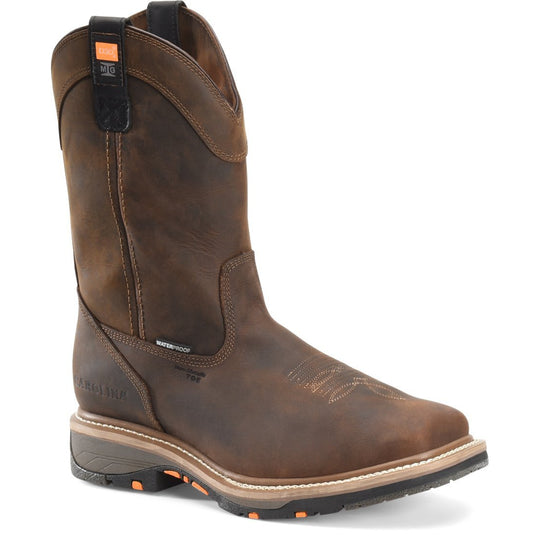
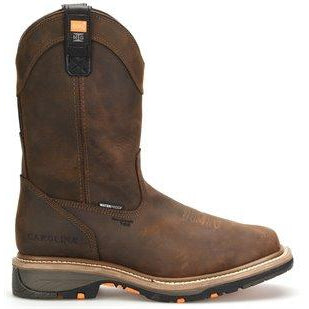
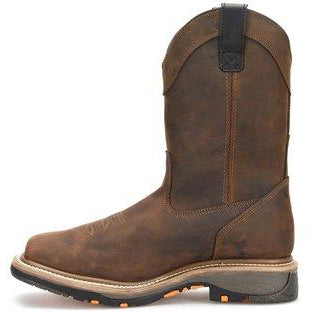
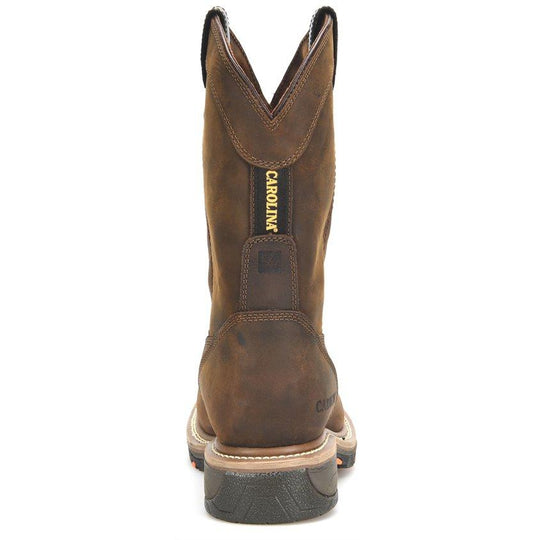
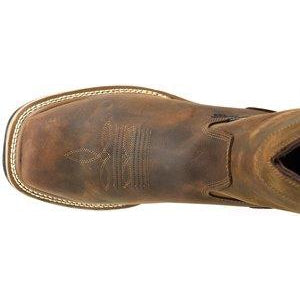
This men’s 11” waterproof composite toe D3O® internal metguard boot provides protection with the agility you need.
Fortified with a D3O internal metguard and a carbon composite safety toe cap for a lightweight feel, this boot is also equipped with our waterproof SCUBALINER™ to help keep you dry in wet conditions.
Key Features of the Carolina CA8537
-
Carbon Composite Safety Toe Cap — A carbon fiber weave cuts toe-cap weight while meeting ASTM F2413 for impact (I/75) and compression (C/75).
-
Winged D3O® Internal MetGuard — Meets ASTM F2413 Class Mt75. A rate-sensitive polymer that flexes as you walk and stiffens on impact.
-
Wide Square Toe — Room across the forefoot.
-
Brown Crazy Horse Leather Upper — Rugged, rich full-grain leather.
-
Waterproof SCUBALINER™ — Carolina's sealed proprietary waterproof lining system.
-
Mesh Lining — Breathable against the foot.
-
Removable Double Tuff Polyurethane Footbed & EVA Midsole — Cushioned support underfoot.
-
Non-Metallic Shank — Composite support with no steel in it.
-
Electrical Hazard Rated — Tested to withstand up to 18,000 volts at 60Hz for one minute without leakage.
-
Welt Construction — Stitched, not bonded; fully resoleable.
-
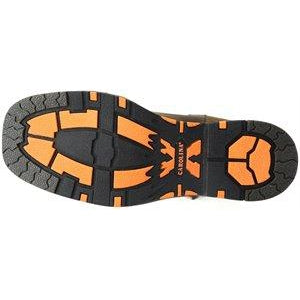
Slip-Resisting Rubber Outsole — Traction on wet and oily ground.
How D3O® Works
D3O® is rate-sensitive. Its molecules flow freely at walking speed, so the guard bends with your foot and you forget it's there. On impact they lock together and the material goes rigid, absorbing and spreading the force. It's the same principle behind motorcycle and military body armour, and it's why a D3O guard can be low-profile and soft without giving up the Mt75 rating.
What a Metatarsal Guard Actually Protects
A safety toe covers the toes and nothing else. The metatarsals — the long bones running from your toes back toward the ankle — sit exposed under thin leather on an ordinary boot. A dropped die, a rolled pipe, or a load slipping off a forklift lands there. An Mt75 guard is rated to absorb a 75-pound-force impact across that whole area.
Nothing Metal in the Toe, the Arch, or the Guard
Carbon composite toe, composite shank, D3O® polymer guard. All three of the components that are usually steel are not steel here — which is why an 11" met-guard boot can weigh what this one does.
Why Choose the CA8537?
Waterproof, EH rated, resoleable, Mt75 met protection — with the agility of a boot that has no metal in its protective components.
Similar Styles to Consider
Want the same D3O® guard in a low 6" shoe? The Miner CA5587. Want the Actuator without a met guard? The CA8535. Browse all met guard boots at Overlook Boots.
Frequently Asked Questions
What is D3O®?
A rate-sensitive polymer. Soft and flexible under normal movement, it stiffens instantly on impact to absorb and disperse force. It lets a met guard be thin and comfortable rather than a rigid plate strapped over your instep.
What does the Mt75 rating mean?
It is the ASTM F2413 metatarsal impact classification. The guard is tested to withstand a 75-pound-force impact across the top of the foot — the same energy threshold used for the I/75 toe rating, applied to a different part of the boot.
Is any part of the protection metal?
The toe cap is carbon composite, the shank is non-metallic, and the D3O® guard is a polymer — none of the three is metal. Carolina does not publish the boot's lace hardware material, so if you need a fully metal-free boot for a detector-controlled access point, confirm before ordering.
Can it be resoled?
Yes. Welt construction stitches the outsole to the upper rather than bonding it, so a cobbler can replace it when the tread wears down.