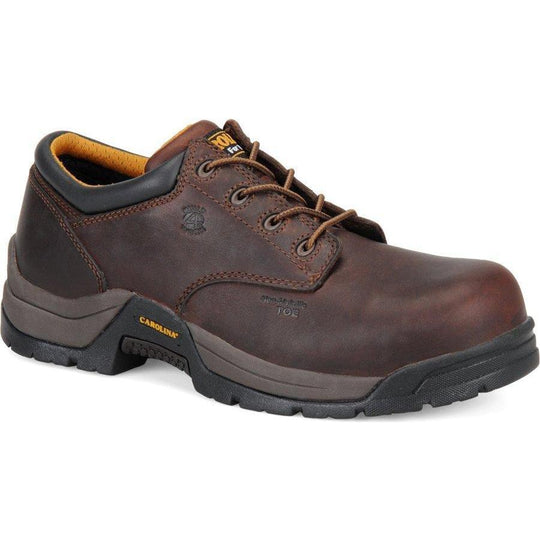
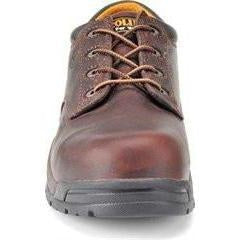
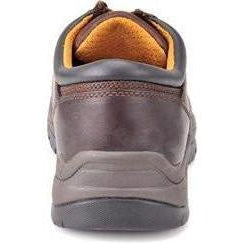
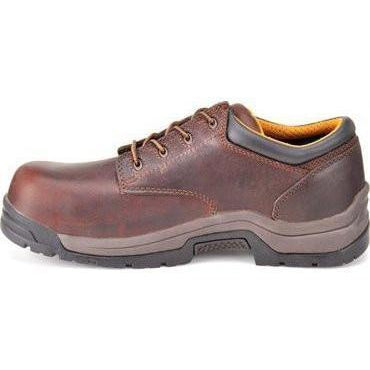
A classic broad-toe oxford with plenty of toe room and a non-metallic composite safety toe, the Braze CA1520 moves easily from the office to the factory floor. Its ESD construction and lightweight, all-non-metallic build make it a smart choice for anyone working around sensitive electronics.
Key Features of the Carolina CA1520 Braze
-
Composite Safety Toe — Non-metallic broad toe meeting ASTM F2413 for compression and impact, with reduced cold transfer.
-
Electrostatic Dissipative (ESD) — Absorbs and neutralizes loose electrons, sending charges into the floor to protect sensitive equipment.
-
Amber Gold Pitstop Leather Upper — Durable, sharp-looking full leather.
-
Removable AG7™ Polyurethane Footbed — Carolina's comfort system, over a Pillow Cushion™ memory-foam insole and EVA midsole.
-
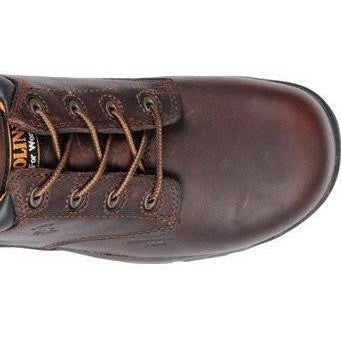
Non-Metallic Shank & Hardware — Composite throughout, down to the eyelets.
-
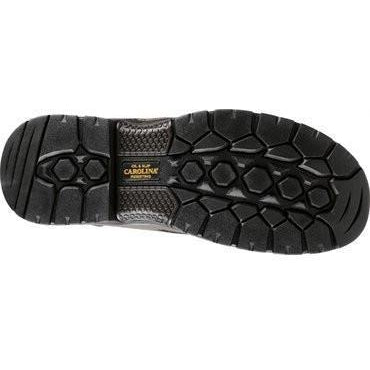
Cement Construction, Oil & Slip-Resisting Outsole — Lightweight, flexible, and grippy.
Static Protection for Electronics Work
ESD footwear channels static charge safely into the floor, reducing the risk of damaging sensitive components. The CA1520 pairs that with an all-non-metallic build — composite toe, composite shank, composite hardware — with no metal anywhere in the shoe.
Broad-Toe Comfort
The broad composite toe gives your toes noticeably extra room — a point wearers consistently single out. The AG7™ footbed and Pillow Cushion™ insole add cushioning underfoot.
Why Choose the CA1520?
It combines a composite safety toe, ESD protection, and a clean oxford profile in one lightweight non-metallic shoe — ideal for electronics, warehouse, and light-industrial settings that call for static control without a bulky boot.
Similar Styles to Consider
Need a composite-toe ESD shoe with a different last? See the Duke CA5541 oxford. Browse the full Carolina collection at Overlook Boots.
Shop more: Carolina Boots, Oxford Work Shoes, ESD Shoes & Boots, Composite Toe Work Boots
Frequently Asked Questions
Can I replace the insole with my own orthotic?
The footbed is removable, but read this first. Carolina notes that if the shoe is worn in an SD-necessary environment, any replacement insole or orthotic must itself be static-dissipative — and even then, the shoe may no longer test SD. If your workplace requires a verified SD reading, check with your safety officer before swapping the footbed.
How much arch support does it have?
Carolina specifies the AG7™ polyurethane footbed as an enhanced-arch-support system. In practice, wearers who need substantial arch correction often add their own insert — the removable footbed makes that easy, subject to the SD caveat above.
Is this shoe EH rated?
The CA1520 is ESD (Electrostatic Dissipative), not Electrical Hazard (EH). The two are different and mutually exclusive: ESD deliberately conducts static to ground, while EH insulates against contact with live circuits. Don't substitute one for the other.
Do they need breaking in?
Expect a short break-in. Reviewers describe the shoe as firm out of the box, with limited give until it's worn a few times, so ease into full shifts rather than starting with one.
Is the toe metal?
The CA1520 uses a non-metallic composite toe, a non-metallic shank, and non-metallic hardware throughout — there is no metal anywhere in the shoe's structure.
What safety standards does the Braze CA1520 meet?
The non-metallic composite toe meets ASTM F2413 for impact and compression, the shoe is ESD (electrostatic dissipative) to protect sensitive electronics, and the outsole is oil- and slip-resisting.