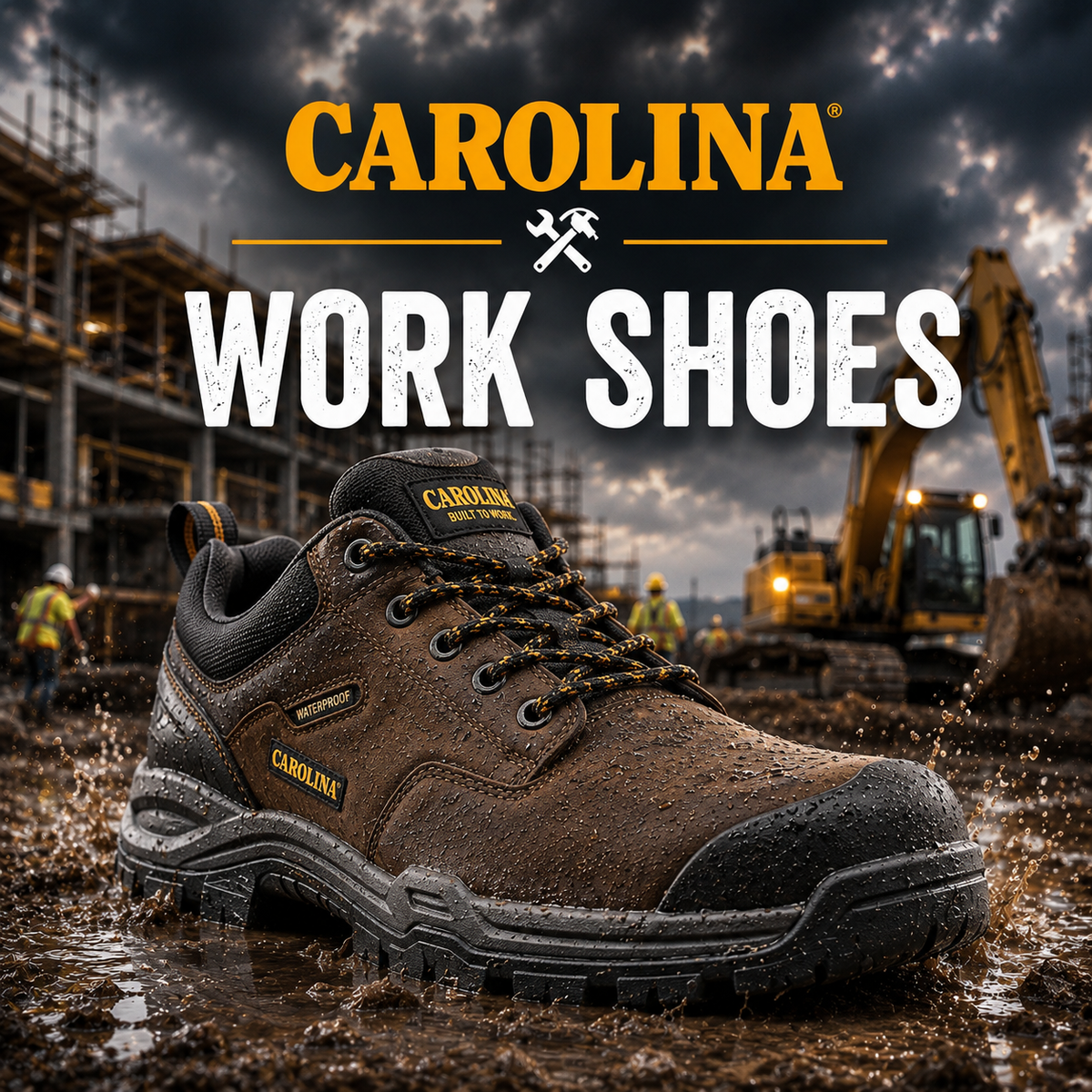
Count on this men’s lightweight athletic aluminum toe internal metguard work shoe for the protection and durability you need.
Fortified with an aluminum safety toe cap and Poron® XRD® internal metguard, this is one hardworking lace-up.
Key Features of the Carolina CA1906
-
Aluminum Safety Toe Cap — A slim-profile metal cap; meets ASTM F2413 for impact (I/75) and compression (C/75).
-
Poron® XRD® Internal MetGuard — A soft, flexible foam that stiffens on impact. Carolina rates its metatarsal guards to ASTM F2413 Class Mt75.
-
Neutral Coco Leather Upper — Durable leather on an athletic last.
-
Mesh Lining — Breathable against the foot.
-
Removable AG8™ Intelli/Sphere Dual-Density Footbed — Premium cushioning with enhanced arch support.
-
Mello/Sphere EVA Cushioning Midsole — Sneaker-style shock absorption underfoot.
-
Non-Metallic Shank — Composite support with no steel in it.
-
Electrical Hazard Rated — Tested to withstand up to 18,000 volts at 60Hz for one minute without leakage.
-
Cement Construction — A bonded sole that keeps the shoe light and flexible.
-
Lytning™ Oil- & Slip-Resisting Outsole with Tech-Tonic Rubber Pads — Traction on wet and oily floors.
Met Protection in an Athletic Shoe
Metatarsal guards usually arrive bolted to a heavy boot, because a rigid plate needs a rigid platform. XRD® changes that. It's a foam — soft and breathable to the touch — whose cells lock together under sudden load, absorbing and spreading impact. That lets the guard sit inside a low athletic shoe instead of strapped over the laces.
What a Metatarsal Guard Actually Protects
A safety toe covers the toes and nothing else. The metatarsals — the long bones running from your toes back toward the ankle — sit exposed under thin leather on an ordinary shoe. A dropped die, a rolled pipe, or a load slipping off a forklift lands there.
Aluminum Toe, Slim Profile
The aluminum toe cap meets ASTM impact and compression thresholds in a lightweight, slim-profile metal cap. Aluminum is a metal, so like steel it transfers cold; if a warm toe box matters more than a slim one, choose the composite-toe CA1907.
Why Choose the CA1906?
Toe and metatarsal protection with an EH rating, in a lightweight athletic work shoe.
Similar Styles to Consider
Want a composite toe and waterproofing on the same platform? The Lytning CA1907. Browse all met guard boots at Overlook Boots.
Shop more:Carolina Boots, Met Guard Boots, Work Shoes
Frequently Asked Questions
What is Poron® XRD®?
A rate-sensitive foam. Soft, thin, and breathable under normal movement, it stiffens instantly on impact to absorb and disperse force, and recovers afterward for repeated hits. XRD is a licensed trademark of Rogers Corporation.
Is the toe cap metal?
Yes. Carolina specifies an aluminum safety toe cap on the CA1906. Aluminum is a metal, so the toe is not non-metallic. The shank is non-metallic and the met guard is foam. For a fully non-metallic toe, the CA1907 uses a composite cap.
How does an aluminum toe compare to steel and composite?
All three meet the same ASTM I/C thresholds. Aluminum is a lightweight, slim-profile metal cap; steel is the traditional metal option; and composite is the fully non-metallic option with less cold transfer.
What widths does the Lytning 1.9 come in?
It comes in Medium and Wide, in men's sizes 8 through 14.
Is the Lytning 1.9 EH rated?
Yes. It's electrical hazard rated, tested to withstand up to 18,000 volts at 60Hz for one minute without leakage.
What footbed does the Lytning 1.9 use?
A removable AG8™ Intelli/Sphere dual-density footbed over a Mello/Sphere EVA cushioning midsole.