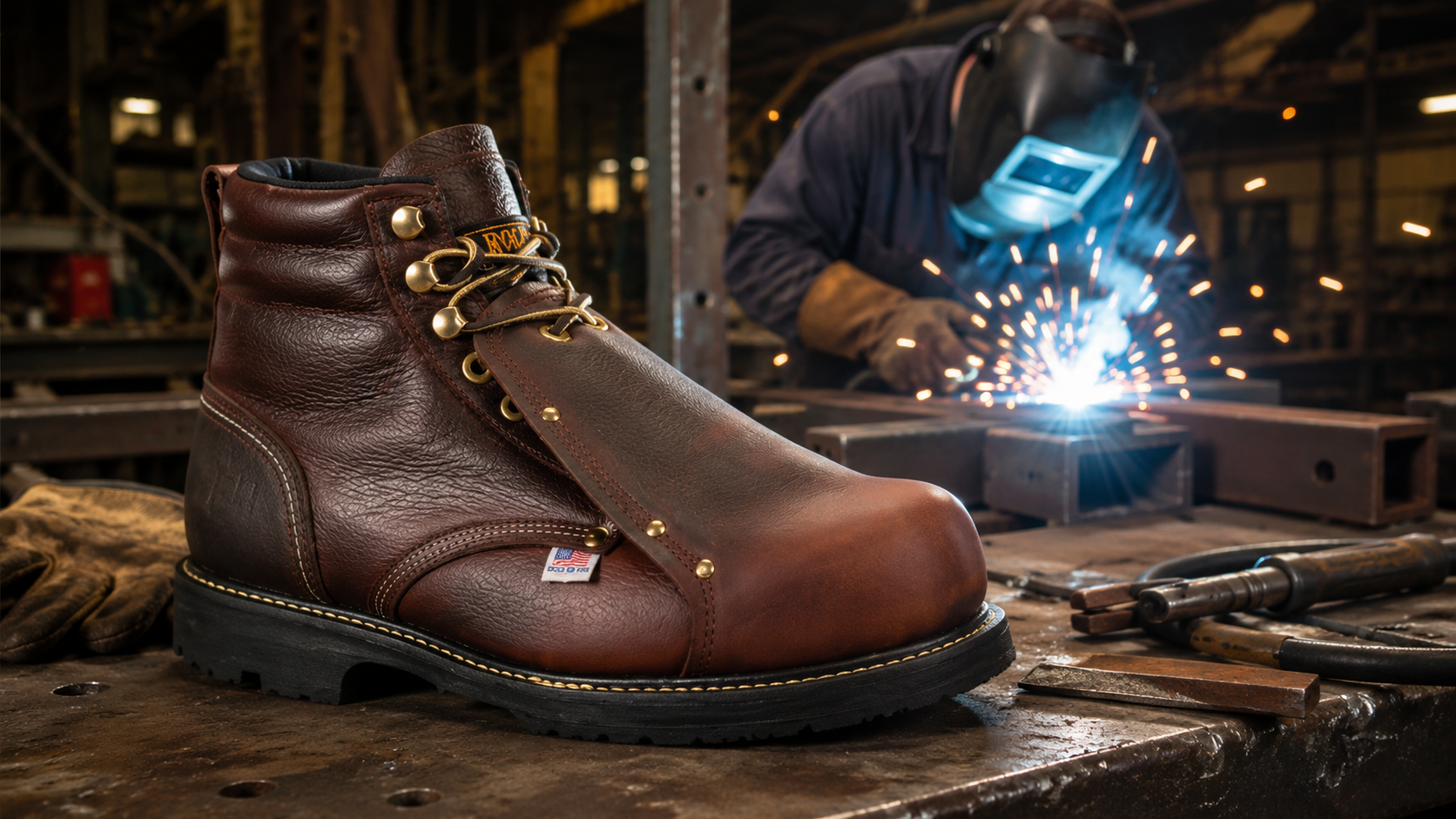
A weld shop is hard on boots. Sparks hit the upper. Slag lands on the toe. Heat comes through the sole. The top of the foot takes hits from dropped tools, plates, and stock. Good boots for welding are built around those hazards, not general jobsite wear. These are the five specs worth checking before you buy.
1. Full-grain leather upper
Full-grain leather is the baseline upper material for welding work boots. It holds its structure better under heat exposure, sheds sparks better than mesh, and gives you more working life before the upper starts to fail.
A spark on full-grain leather leaves a scorch mark. A spark on a mesh or a synthetic panel leaves a hole. That is the difference that matters in a weld shop.
The Carolina CA3630 uses Copper Crazy Horse leather, an oil-tanned leather that takes abrasion, shop grime, and repeated conditioning better than lighter upper materials. The Ariat Groundbreaker also uses a full-grain leather foot with a leather or suede upper, which puts it in the right material category for welding-adjacent work.
The toe design matters too. Some moc-toe boots put stitching where sparks land. Standard nylon or polyester thread burns through under repeated exposure. For a moc-toe style, check whether that seam is protected or whether the stitching holds up to heat exposure. Round-toe boots avoid that exposed toe-face seam altogether.
2. ASTM F2413 safety toe
A safety toe that meets ASTM F2413 matters because welding work puts falling tools, pipe, plate, and stock near your feet. OSHA-required footwear depends on the site hazard assessment, but the standard to look for on the boot tag is ASTM F2413.
For welding, the practical question is steel-toe or composite-toe. Both meet ASTM F2413 when certified. Steel-toe boots are still common on heavy industrial sites because they are familiar and proven. The Carolina CA3630 uses a steel safety toe cap, and the Ariat Groundbreaker also features a steel toe metguard.
A composite toe is worth considering when heat transfer is a concern. Steel conducts heat and cold. Composite does not. The Danner Power Foreman 15210 uses a lightweight non-metallic composite toe and is listed as meeting ASTM F2413. It suits a buyer who wants toe protection without adding a metal toe box to a hot work environment.
When your site calls for steel, buy steel. When your work puts your toes close to hot metal for long stretches, start your comparison with composite toe boots and check the ASTM marking first.
3. Metatarsal protection
The safety toe protects your toes. It does not cover the long bones across the top of your foot. That is where metatarsal protection comes in.
Top-of-foot impact is common around welding and fabrication. A tool slips. A plate shifts. Slag drops from above. The toe cap does nothing if the hit lands behind it.
A metguard covers that gap. The Carolina CA3630 uses a heavy plastic and dense foam-lined external MetGuard. The Ariat Groundbreaker uses flexible XRD® Extreme Impact Protection metatarsal guards and is marked ASTM F2413 M/I/C Mt EH. The Carolina 508, also listed in the welding collection, is an internal metguard boot.
External guards sit over the boot and cover the lace section. That helps when sparks are part of the daily work. Internal guards sit under the leather. They are slimmer and easier to move in, but they do not protect the laces.
For jobs with falling stock, overhead work, or heavy shop material, start with Metguard boots. For high-spark work, external metguards usually make more sense. For mixed-duty work where you need more flex, internal metguards are easier to live with.
4. Electrical hazard protection in the outsole and heel
Welding is not only a heat-related job. It is an electrical job too. Leads, power tools, grounded tables, and damp concrete share the same work area.
A boot with electrical hazard protection adds a secondary layer through the outsole and heel. It does not replace safe electrical practice. It does not make a wet floor safe. It does matter when electrical exposure is part of the hazard assessment.
The Carolina CA3630 includes electrical hazard protection. The Ariat Groundbreaker is marked ASTM F2413 M/I/C Mt EH. The Danner Power Foreman 15210 also lists electrical hazard protection. Those details are worth checking because two boots look similar on the shelf while carrying different safety markings.
When your shop or jobsite requires electrical hazard protection, check the boot tag and product specs before you buy. Do not assume that every safety toe boot includes it. For that specific requirement, compare electrical hazard work boots and confirm it on the product page.
5. Outsole compound, traction, and shaft height
The outsole has to match the floor. Welding shops bring smooth concrete, metal grating, oily patches, slag, wet entryways, and hot debris. A soft sole that feels good on concrete falls short on rough outdoor work. A hard lug that bites outdoors feels clumsy on flat shop floors.
That is why the outsole spec deserves more attention than it gets. The Carolina CA3630 uses an oil- and slip-resisting rubber outsole with a steel shank. The Ariat Groundbreaker uses an oil- and slip-resistant Duratread sole with a 90-degree heel. The Danner Power Foreman uses a Vibram 4014 Christy outsole, which grips smooth surfaces such as concrete and wood.
Do not assume “rubber outsole” tells the whole story. Check whether the sole is listed as oil-resistant, slip-resistant, heat-resistant, or built around a named compound. For jobs with hot surfaces or heavy slag exposure, choose heat-resistant safety boots rather than a general work boot sole.
Boot height matters too. Six inches is the practical minimum for most shop work. Eight inches gives better ankle coverage and keeps more sparks and debris out of the boot when you are crouched over the work. The Danner Power Foreman and Danner Rain Forest models in the welding collection both come in 8-inch configurations. For heavy work socks, size up a half size when the fit runs tight.
Frequently Asked Questions
Do welding boots need to be lace-free?
No, welding boots do not need to be lace-free, but standard laces are a weak point in high-spark work. Sparks burn through laces over time. An external metguard covers the lace section. Pull-on and slip-on boots remove the lace issue completely, which is why some shop workers prefer them.
What is the difference between an internal and external metguard?
The difference between an internal and an external metguard lies in where the guard sits. An external metguard sits over the boot, covering the laces. An internal metguard is built into the boot and sits under the leather. External guards give more spark and lace coverage. Internal guards are slimmer and easier to move in.
Are steel-toe or composite-toe boots better for welding?
Composite-toe boots for welding are the better pick when heat transfer is critical. Steel-toe and composite-toe boots both meet ASTM F2413 when certified. Steel is common on heavy industrial jobs. Composite is lighter and does not conduct heat or cold. The right choice comes down to the site requirement and the type of exposure around your feet.
Do welding boots need to be waterproof?
Welding boots do not always need to be waterproof. Indoor shop work does not require it. Outdoor welding, wet concrete, yard work, and winter jobsite conditions do. Waterproof liners add protection and also make the boot warmer. The Danner Power Foreman 15210 uses a GORE-TEX waterproof lining, which makes sense for wet industrial work more than a dry indoor shop.
How tall should welding boots be?
Welding boots run at least 6 inches tall for shop work. An 8-inch boot gives better ankle coverage and keeps sparks and debris out when you are crouched, kneeling, or leaning over the work. Pipe welders, outdoor welders, and anyone working around overhead sparks get more from the taller shaft.
How do I care for leather welding boots?
To care for leather welding boots, clean off slag, grit, and debris after each shift, and condition the leather regularly. Heat dries leather faster than normal wear. Once the leather cracks, it loses the protection you bought it for. Do not power-wash leather boots. It strips the oils, and the leather cracks within a season.